Thermal Paper Roll Specification Checklist for Middle East Importers
A reliable thermal paper RFQ should describe the physical roll, paper grade, printing requirement, packing method, inspection plan and destination. If the request says only “80mm thermal paper, best price,” suppliers may quote different lengths, cores, materials and carton configurations that cannot be compared fairly.
Record the Physical Roll Specification
Use named fields and measurement units. Do not rely on a compact size label unless both parties define it in the same way.
| RFQ field | Example format | Why it matters |
|---|---|---|
| Width | 80 mm | Matches the print mechanism |
| Outer diameter | Maximum 80 mm | Determines compartment fit |
| Core ID and OD | Millimetres | Affects loading and usable diameter |
| Roll length | Metres with tolerance | Enables value comparison |
| Paper weight | GSM | Influences thickness, feel and length |
| Winding | Coated side out or in | Places the thermal side against the head |
| End treatment | Glued, taped or loose | Affects final feeding and handling |
If the team does not know these values, measure an approved current roll and send it with the exact printer model. Our thermal roll product pages can help organize common options, but they do not replace device qualification.
Define the Paper and Print Performance
“High quality” is not a testable specification. Describe what the receipt must do and where it will be used.
Useful qualification fields include:
- Printer model, speed and normal density setting.
- Required fresh print contrast and barcode or QR readability.
- Expected warehouse and point-of-use environment.
- Contact with oil, moisture, plasticizers, alcohol or abrasion.
- Required unprinted stock life and printed-image retention conditions.
- Material preferences such as BPA-free, BPS-free or phenol-free.
- Required declarations, test reports or batch documentation.
Do not treat top coating, high sensitivity, water resistance and long image life as interchangeable claims. Each describes a different property and needs its own grade-level evidence or project test.
Specify Custom Printing as a Controlled Process
For Arabic-English or branded receipt rolls, add an artwork section to the RFQ. State whether the design is printed on the thermal face, back or both sides. Include colour count, repeat length, logo dimensions, fixed terms, variable-field clearance and version count.
The approval package should include:
- Final artwork with fonts converted or supplied correctly.
- A marked safe area for POS-generated text and QR codes.
- Arabic-language review by the buyer or an authorized reviewer.
- PDF proof showing winding and repeat direction.
- Physical printed sample tested on the actual device.
- Signed approval identifying the artwork revision.
Visit our custom-printed thermal paper section when the project includes logos, fixed text or private-label presentation.
Compare Packing and Logistics, Not Just Roll Price
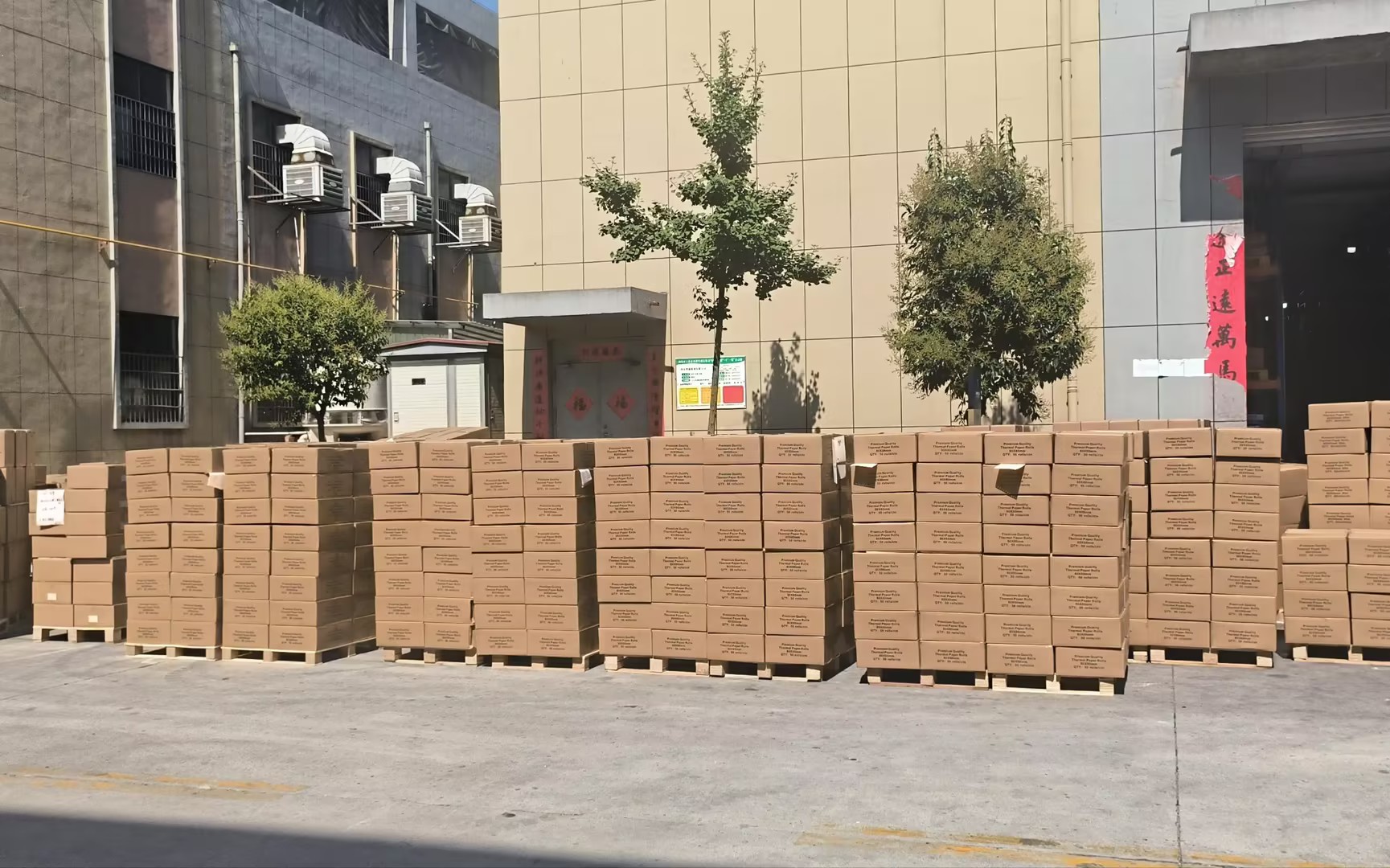
Middle East import projects may include long sea transit, container heat, handling and warehouse storage. The RFQ should state individual wrapping, rolls per pack, packs per carton, carton dimensions, gross weight, pallet requirement and any moisture or crush protection.
Also provide the destination port or delivery address and requested trade term. A supplier cannot compare FOB, CIF and delivered offers accurately without the destination and shipment size.
For mixed-SKU orders, define how each size will be identified. Carton labels should show the SKU, dimensions, quantity, production batch and any customer reference. This reduces receiving and distribution errors.
Add an Inspection and Repeat-Order Plan
Sample approval is the beginning of control, not the end. Retain a signed master sample and purchase specification. Agree how width, diameter, core, length, print density, artwork position and packing will be checked.
For repeat orders, require a clear change-notification rule. A change in base paper, coating grade, core, ink, artwork or packing can affect device performance or customer acceptance. Batch traceability helps investigate complaints without assuming every roll is identical.
Frequently Asked Questions
Why do two 80 x 80mm quotations have different prices?
They may use different roll lengths, GSM, cores, materials, tolerances or packing. Ask each supplier to complete the same specification sheet before comparing price.
Should the RFQ specify both GSM and roll length?
Yes when both matter. GSM affects thickness and hand feel, while roll length defines usable paper. At a fixed outer diameter, changing thickness can change length.
Is a printer model enough to approve the roll?
It is a strong starting point but not always sufficient. Device revisions, local settings and custom printing can change the result. Test an actual sample under the intended conditions.
Use our quotation form to submit the destination, device list, roll specification, annual volume and custom-printing files in one project brief.
Need thermal paper, labels, or NCR forms?
We normally respond within 24 hours after we receive complete product specifications, quantity, packaging, and destination details.